

If you’ve seen our content, you won’t be surprised to know that vaginismus plays a big role in how Damien and I interact sexually. What you might not know is how many messages we receive every day from both women and men asking for advice. We have done our best to respond to everyone over the last several years, but I thought it was finally time to consolidate my advice, my thoughts, and my story, and to share it someplace where others can find it… even if they’ve never seen us naked! 😂
Please know this is not official medical advice, just my personal experience combined with several years of research. With that out of the way, here’s what I know and what I’ve been through 💛
What is Vaginismus?
Vaginismus is a medical condition involving involuntary vaginal contraction during attempted penetration, making the experience painful or impossible. “Penetration” doesn’t just mean sex, but also gynecological exams or using tampons. You might also hear it by its more clinical name, genito-pelvic pain/penetration disorder (GPPPD), which is a mouthful, but handy to know if you ever bring it up with your doctor. Vaginismus is an understudied condition. Many people might think it’s just due to anxiety, but it can be more complicated than that. Here is a non-comprehensive list of factors that may be involved:
- Past trauma, especially sexual abuse
- Sexual inexperience
- Lack of complete arousal
- Anxiety, especially in relation to penetration
- Extra sensitivity
- Side effects from medication (ex: birth control or SSRIs)
- Allergens
- Bacterial or viral infections
- Menstrual/hormonal changes
- Physical injury
- Misalignment in position during penetration
- Purity culture (a strict religious upbringing)
- Not enough lubrication
The good news is that more attention has been drawn towards this issue in recent years! If you or your partner are experiencing vaginismus, don’t despair. It doesn’t need to rule your life, as there are lots of options to pursue.
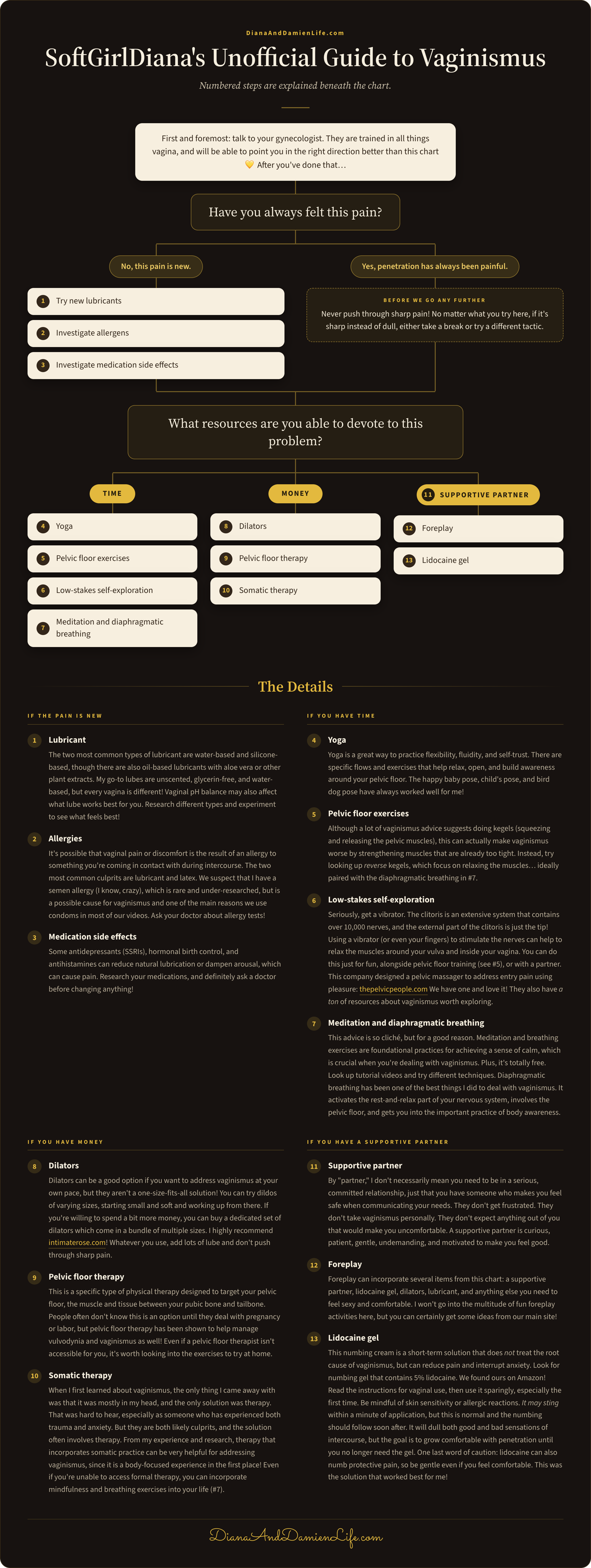
Feel free to share this image! Download the chart
My Story
My experience with vaginismus has spanned my whole adult life, peaking right around the time when Damien and I met. For me, the causes were complex. I’ve always been a sensitive person (which if you’ve seen our videos, you know this can be really fun), but I also had some bad experiences at a formative time in my life. Before Damien, I had never had successful or pleasurable penetrative sex.
As we began to fall in love, I found myself feeling safe with him in a way I never had before… safe enough to explore sex with the express goal of mutual pleasure and connection. I opened up to him about my experience and he met me with total understanding and patience. Slowly, very slowly, we began to work through it. We started our sexual relationship by experimenting with pleasure outside of penetrative intercourse, which built a solid foundation of safety and intimacy. This included fingers, dilators, breathing exercises, oral, outercourse, and a variety of lubricants. I remember the first time he successfully slipped a finger inside me without pain. I was so relieved and surprised that we just laughed and laughed together!
But a penis is different from fingers, and it required a more complex solution to address the burning pain I felt when we attempted penetrative sex. The process of using dilators was not fun, and I found myself tensing more as I anticipated the pain. Even though I was aroused, even though I felt safe, my body was not responding.
Damien didn’t get frustrated; he kept assuring me, supporting me, and researching with me. We stumbled upon what ended up being the solution: 5% lidocaine gel.
He bought it on Amazon for about $15, then we made a plan to use it when he visited me at college. After some foreplay, he gently massaged the gel into the muscles of my vagina. We didn’t need to go very deep since the pain was mostly located at the entry. The gel stung within a few seconds after he applied it, but only for a few moments. We let it sit for five minutes, enough time for the muscles to numb, then, equipped with a condom and water-based lubricant, he entered slowly. The first time was just about taking in length with as little movement as possible. This was a form of exposure therapy. The vagina is strong, full of nerves and muscles that learn to accommodate the experiences of living. Once we numbed out the pain, that’s exactly what happened! The goal wasn’t to immediately transition into orgasmic sex, it was to help my body realize that penetration was safe. Much to my surprise, it worked incredibly well, and we only ended up using the gel a handful of times before we were able to do the process without it!
The truth is that the vaginismus pain has never truly subsided. Most of the sex we have now is very pleasurable, but we always start slow and I often feel the burning sensation once the euphoria has worn off. There have been a few stretches, maybe a couple weeks at a time, where it felt like we were back at square one.
This happened when I first got an IUD. I want to make it clear, everyone is different, and IUDs can be lifesavers for many people, especially by reducing pain and bleeding. That was not the case for me, and I ended up getting it removed a year and a half later. Again, we patiently started the process over, and within a few weeks, sex was amazing again.
Today, I still experience some burning with entry or after intercourse, but those times are fleeting and are usually tied to my cycle. During those times, we use extra lube, go a little slower, and use a vibrator to release tension in the outer vaginal muscles. It takes a lot of patience, curiosity, and commitment, but for us, it has been worth it 💛
Resources mentioned in the chart
- The Pelvic People — they designed a pelvic massager to address entry pain using pleasure. We have one and love it!
- Intimate Rose — a dedicated set of dilators that come in a bundle of multiple sizes. I highly recommend them!